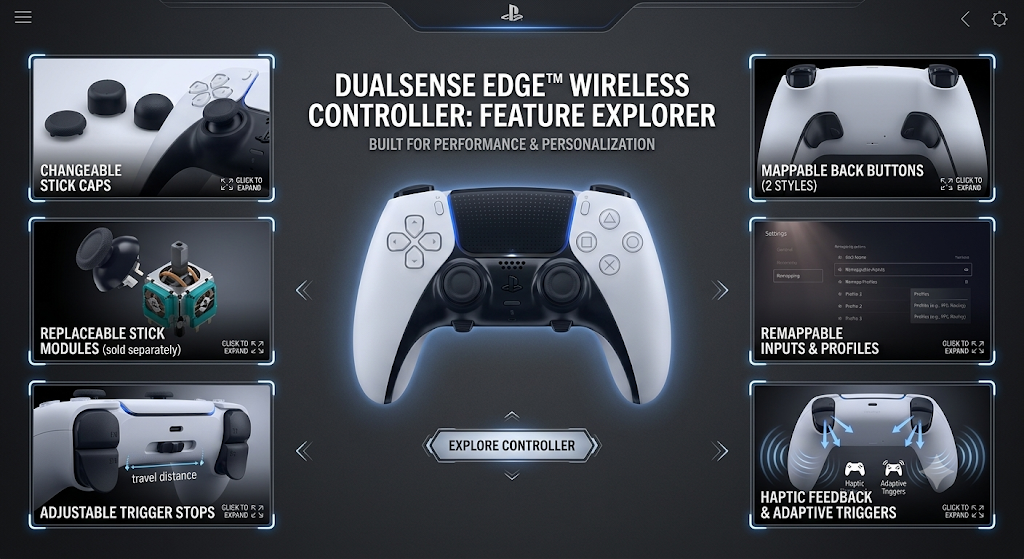
The core PS5 experience is already in both
Both controllers retain the signature PlayStation experience: haptic feedback, adaptive triggers, motion controls, a built-in microphone, and the familiar DualSense shape. Sony specifically describes the Edge as retaining the immersive features of the standard controller.
That matters because the Edge does not unlock a completely different class of games. It improves control and customization around the same underlying PS5 experience.
The practical differences
| Feature | Standard DualSense | DualSense Edge |
|---|---|---|
| Rear controls | None | Two mappable rear inputs with two included button styles |
| Trigger travel | Standard adaptive triggers | Physical L2/R2 stop sliders plus adjustable trigger settings |
| Profiles | Standard PS5 controller settings | Save and switch custom control profiles on the fly |
| Stick customization | Fixed stick modules and standard caps | Changeable caps and separately replaceable stick modules |
| Button mapping | System accessibility options | Extensive per-profile remapping and sensitivity tuning |
| Battery experience | Better fit for ordinary wireless use | Shorter sessions were the main complaint in our testing |
| Best fit | Most PS5 players | Competitive and customization-focused players |
Rear buttons and profiles are the real upgrade
The most meaningful difference is not the finish or carrying case. It is the ability to keep important actions under your fingers without leaving the sticks, then switch complete control profiles without rebuilding settings every time.
Sony’s official feature set includes quick-swap profiles, button remapping, stick sensitivity and dead-zone adjustment, trigger dead-zone control, swappable caps, back buttons, and replaceable stick modules.
In Warzone, the rear controls can reduce awkward face-button movement. In Elden Ring, a customized profile can move frequently used actions into more comfortable positions. In Gran Turismo 7, keeping greater trigger travel makes more sense than the short shooter configuration.
Replaceable stick modules are more than a gimmick
The Edge allows an individual stick module to be removed and replaced separately if it develops a problem. Replacement modules are sold separately, but that repair path is still valuable on expensive hardware. Sony documents the module as user-replaceable.
The standard DualSense does not offer the same modular replacement design. For players worried about long-term analog-stick wear, this is one of the Edge’s strongest arguments.
The premium only works when the features become habits
The Edge is not automatically better value just because it has more controls. Its shorter battery life was the clearest weakness during 60+ hours of testing, it provides only two rear inputs, and its extra weight is noticeable during long sessions.
A player who never builds profiles, leaves the trigger stops untouched, and rarely uses the rear controls is paying for a toolkit that remains in the case. The standard DualSense already supplies the adaptive triggers and haptic feedback that define the PS5 controller experience.
Choose based on how you actually play
Choose Standard DualSense
- You mainly play casual or single-player games
- You rarely remap controls
- You want the familiar PS5 experience at a lower cost
- You prefer simplicity over extensive tuning
- You need an extra household controller
Choose DualSense Edge
- You play competitive shooters regularly
- You want rear controls without leaving the sticks
- You switch among game-specific profiles
- You use trigger stops and sensitivity settings
- You value replaceable stick modules
Worth it—but only for the right player
The standard DualSense is the smarter recommendation for most people because it already delivers the PS5’s defining controller features. The DualSense Edge becomes worth the premium when customization is not theoretical—when rear controls, quick profiles, trigger stops, and replaceable modules solve problems you repeatedly encounter.
Bottom line: keep the standard DualSense unless you can immediately name the two rear actions and at least two custom profiles you would use.
Feature references
This comparison separates our testing impressions from official feature information. Controller capabilities were checked against PlayStation's official DualSense, DualSense Edge, and replacement stick-module pages.